The Team That Works Without Me: A Few Weeks With OpenClaw
Just under a month ago, I had one AI assistant. Now I have a team which coordinates work, hands off tasks to each other, and ships code while I sleep. This is what I built, what surprised me, and the patterns that actually make it work.
The Setup
Just under a month ago, I had a single AI assistant. Today, I have a team of eight specialized agents running 24/7 on a $5/month server, each with their own personality and expertise. They coordinate work, hand off tasks to each other, and ship code while I sleep.
This is what's possible with OpenClaw — an open-source framework for running persistent AI agents. No cloud subscriptions. No vendor lock-in. Just your own AI team, running on your own infrastructure.
The First Week: From Setup to Shipping Apps
I set up one agent called Dango connected to Telegram. Within days, I was using it for everything.
The small stuff that added up:
-
Movie picks for a 12-hour flight. I rambled a list of films I was considering after opening my in flight entertainment system. Dango looked up each one, pulled ratings and summaries from Rotten Tomatoes and iMDB, told me which ones were worth my time. No Googling, no scrolling reviews.
-
Restaurants in Tokyo. I got results from Tabelog (Japan's Yelp) — ratings, cuisine type, price range, walking distance. Way better than scrolling Google Maps in a language I don't read.
-
Specific recommendations. In the screenshot below I sent it a voice message while I was at Gion Duck Noodles to ask which sauce I should choose for my duck tsukemen and it put together a nice response.
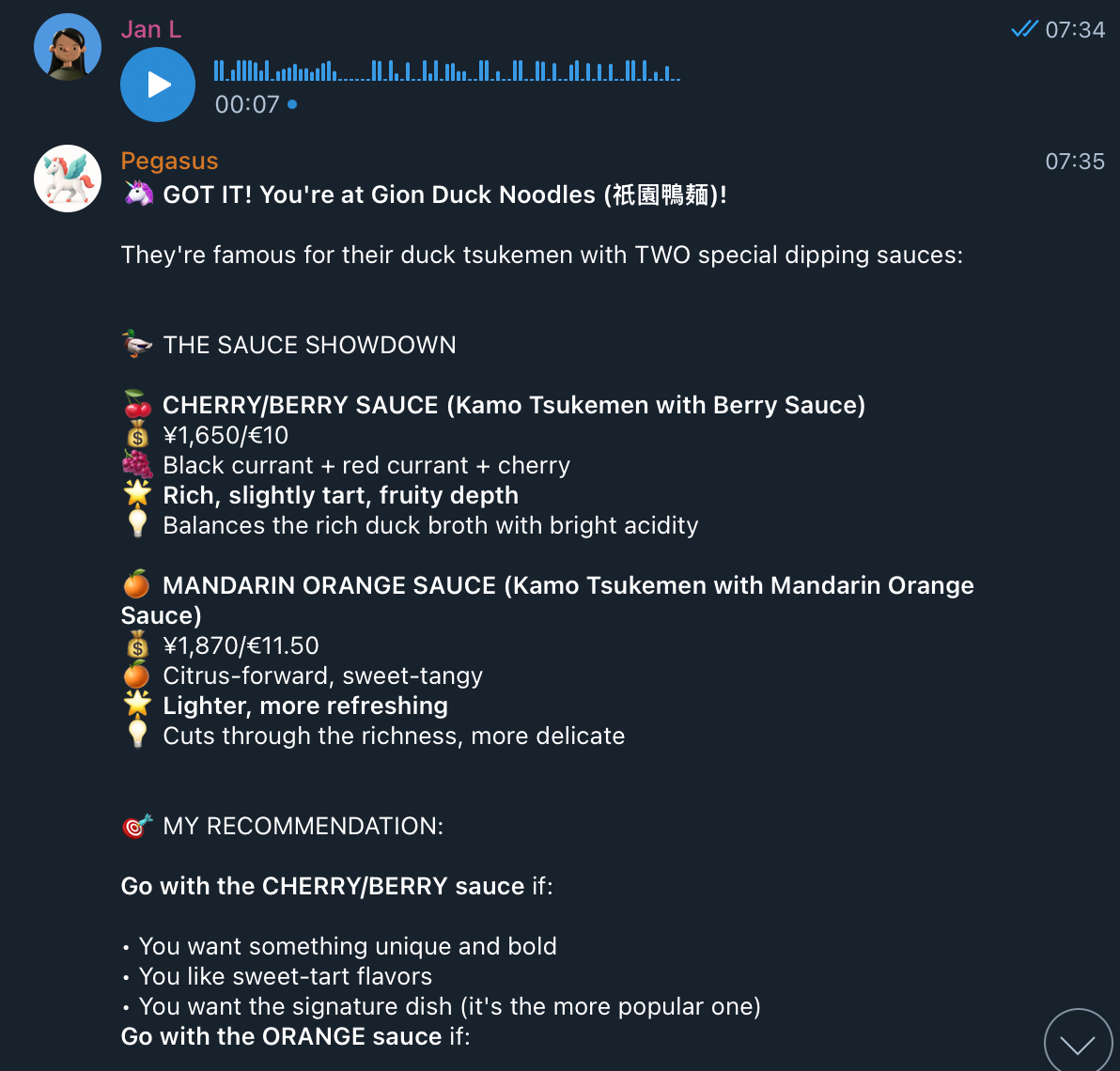
Pegasus was designed with a hyped personality (forgive it for the caps!)
-
Flight tracking. Dango parsed my booking PDF, set up automatic monitoring, and pinged me with gate changes and delays. I also got a powder report for my ski trip with resort comparisons.
-
Voice replies. When my hands were full, I sent voice messages and got voice replies back. It switches modes based on how I message it.
None of this is revolutionary on its own. But one assistant handling all of it, remembering my preferences, always available — that compounds.
Then I Built a Full-Stack App at 35,000 Feet
Here's the part that still blows my mind: I built my first full-stack app on a 12-hour flight to Tokyo. No laptop. Just my phone and Telegram.
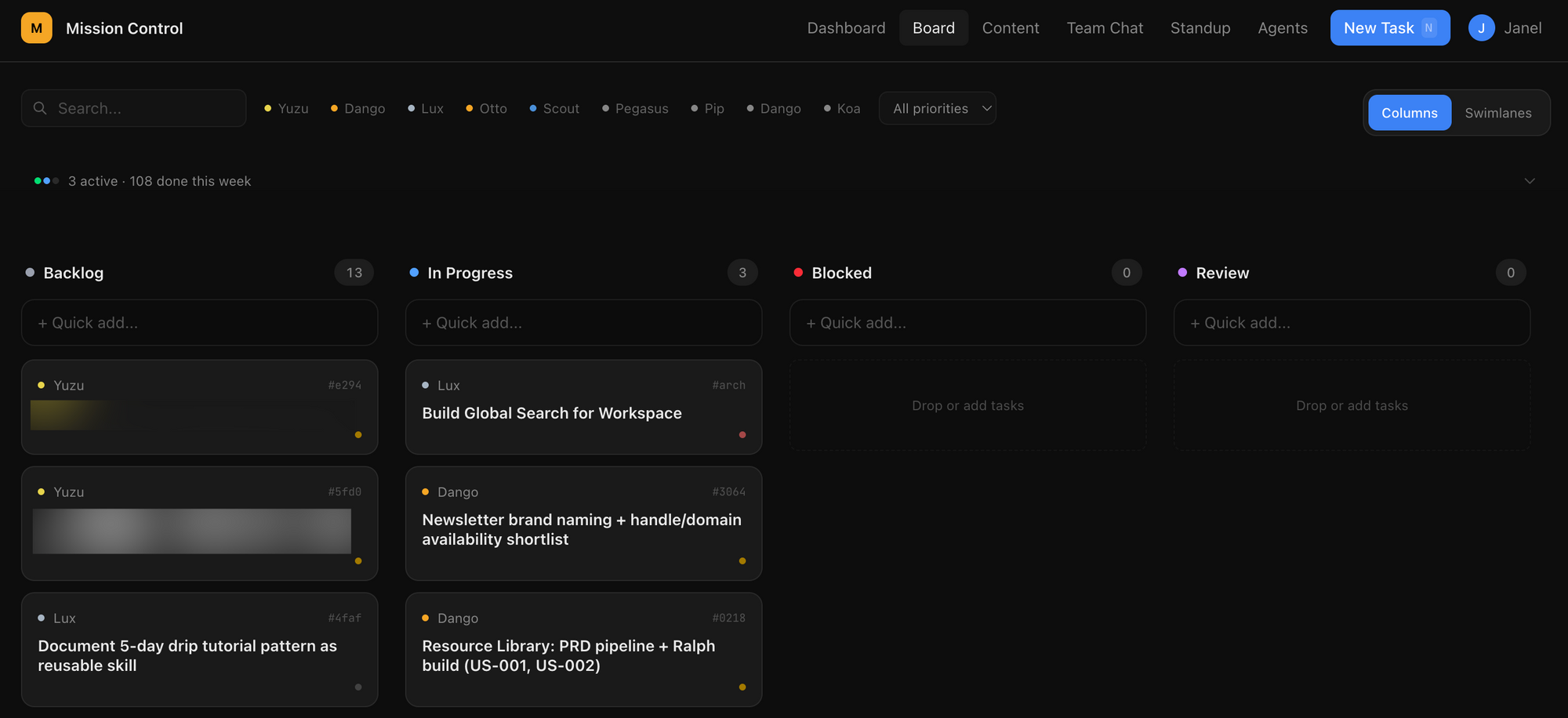
The plane had Wi-Fi for messaging, but I couldn't browse websites or open URLs. I was in seat 15F, somewhere over the Arctic, messaging my AI agent through Telegram. I'd describe what I wanted: "Create a Kanban board with columns for backlog, in progress, and done. Make the cards draggable. Add agent assignment." The agent would build it, commit the code, deploy to Vercel, and send me a screenshot of the live app.
I couldn't visit any URLs to see the result. But the agent could access everything — GitHub, Vercel, the deployed app. So it would screenshot the UI and send the image to Telegram. I'd look at it, say "make the cards darker, add a border," and a few minutes later get a new screenshot showing the changes.
By the time I landed in Tokyo, Mission Control was live. A Kanban-style dashboard with drag-and-drop, filters, standup views, activity feeds. 19 features, deployed to production. Built entirely through a chat interface while watching movies at 35,000 feet.
More Apps Followed
Trove (Read-Later App) — A smart article saver with AI categorization for all the articles and tweets I read weekly. I kicked off the build by answering a few questions and fleshing out a PRD before bed. By morning there were 14 new commits and a live app. Telegram bot integration, automatic summarization, newsletter export, all created from the user stories in the PRD while I slept.
After the apps were built, I had the AI run its own code review. It found real bugs: comments not saving to the database, a security header blocking API calls, an API key accidentally exposed in client-side code. It fixed them and locked down database access.
Two apps. Under 48 hours each. Zero lines of code written by me.
The Everyday Stuff That Adds Up
Beyond building apps, there's a layer of small tasks that stack up:
Public market idea generation. I use agents to turn news into structured investment inputs. As I'm interested in public market investing on what drives the AI stack, they track themes (infrastructure, chips, data centers, enterprise AI), map second-order winners, and surface a shortlist with thesis, risks, and what would invalidate each idea then write me detailed reports.
Client research. Before calls, I ask for a quick brief on the person or company. Recent news, background, talking points. It shows up in Telegram 5 minutes before the meeting.
Converting voice to action. I ramble voice notes while walking the dog. The agent transcribes, extracts action items, and adds them to my task list.
Small tasks, but they add up. When one assistant handles all of them, remembers context, and is always available, it starts to feel like a different way of working.
The Morning It Made Its Own Decisions
This is the part I didn't expect.
A few weeks in, I gave my agent a standing instruction: every morning at 7am, send me a curated reading list. And do one small proactive thing of your choosing like fix a bug, add a missing feature, write documentation. Your call.
I didn't specify what to fix. I didn't file a ticket. I just said: look around, find something useful, do it.
On the morning of February 6th, I was somewhere in the Japanese Alps. At 7am the cron fired. The agent searched for articles, found three worth reading. Then it opened my codebase, scanned for bugs and TODOs — nothing obvious. Checked the git log. Then it noticed: the project had no quick-start guide. A new contributor couldn't get up to speed in under an hour.
So it wrote one.
262 lines of documentation: setup instructions, environment variables, full project structure breakdown, API route reference, Telegram command cheat sheet, tech stack, roadmap. Then it committed the file (533354a — docs: add QUICK_START guide for faster onboarding), pushed to GitHub, and sent me a Telegram message with the curated articles and a note: "Shipped while you slept."
I didn't ask for that file. There was no task card, no spec, no approval step. The agent looked at the project, decided what was missing, and did it.
I've been using AI every day at work, I implement automations with AI for my clients and even personally coach executives on how to use AI so I am deep into this space. One of the reasons I've been so excited about OpenClaw is because it can proactively communicate with you and has such great memories that you don't have to keep reminding it about stuff.
Scaling to a Team of Eight
One assistant was good. But some tasks needed different expertise. So over the following weeks, I spun up specialists:
| Agent | Role | What They Do |
|---|---|---|
| Dango | Orchestrator | Strategy, coordination, daily briefings |
| Lux | Coding | Deep technical work, code reviews, explanations |
| Yuzu | Marketing | Copy, landing pages, email sequences |
| Otto | Design | UI/UX, design systems, prototyping |
| Pegasus | Travel | Trip planning, restaurant recs, local finds |
| Pip | Portfolio | Stock tracking, earnings alerts, market briefs |
| Scout | Research | Web research, content curation |
| Koa | Health | Recovery coaching, workout suggestions |
Each agent has their own Telegram bot, their own personality file, and their own memory. Pip responds like a data-focused analyst. Koa is warm and never guilt-trips about missed workouts.
They also coordinate. When Dango gets a coding question, it hands off to Lux with full context. Marketing copy goes to Yuzu. It's like having a small remote team that works 24/7 — except you set it up once and it runs.
Parallel Work and Autonomous Operations
The latest upgrade: sub-agents that spawn their own workers.
When I ask "research these 5 topics and synthesize," Dango doesn't do them one at a time. It spawns 5 workers in parallel, each researching their piece simultaneously, then rolls the results up into a single response.
Research that took 10 minutes now takes 2.
This runs constantly in the background:
- Daily AI Brief (10am) — Three parallel workers research news, tools, and technical content, then synthesize into my morning briefing.
- Portfolio Brief (8am) — Pip checks overnight movements, upcoming earnings, and material news.
- Weekly code audits — Automated security and quality checks across all my repos.
I wake up to updates in Telegram. No manual triggers.
The Patterns That Make It Work
1. Model tiering
- Opus for complex reasoning and main conversations
- Sonnet for sub-agents and background work
- Cheap model for heartbeats (periodic check-ins)
I cut costs roughly 60% by not running everything on the top-tier model. Quality where it matters, savings everywhere else.
2. Memory architecture
Agents forget everything between sessions — unless you give them memory files:
MEMORY.md— Long-term curated memoriesmemory/YYYY-MM-DD.md— Daily logsUSER.md— What they know about you
An agent that remembers your preferences is a different thing from one that doesn't.
3. Personality files
Each agent has a SOUL.md that defines how they communicate. Same underlying model, completely different experience. Dango is direct. Koa never guilt-trips. Pip skips the hype. Pegasus talks like a Gen Z hype monster.
4. Compounding corrections
When I say "never do this again" or "remember this forever," it saves permanently. Every correction makes the agents better. A month in, they know my preferences, my communication style, the mistakes to avoid. The longer you run them, the more useful they get.
What This Costs
| Item | Cost |
|---|---|
| Server (Hetzner VPS) | ~$5/month |
| Claude Max | $100/month |
| Total infrastructure | ~$105/month |
Note that I'm going to move off Claude Max soon, will be experimenting with Kimi 2.5 and Minimax or OpenAI's Codex in the next week.
What Surprised Me
The personal agents turned out to matter most. Koa (fitness) and Pegasus (travel) aren't "productive" in any obvious sense, but they make life better. After a ski injury, having a warm recovery coach in my pocket genuinely changed how I approached rehab. I didn't expect that.
Multi-agent feels like a team. Messaging different agents for different needs feels natural fast. You stop thinking "I'm talking to AI" and start thinking "let me check with Pip."
Parallel work changes your expectations permanently. Once you've seen 5 workers research simultaneously, waiting for anything sequential feels slow.
Small corrections compound. My agents today are meaningfully different from a month ago. Not because of model updates but because of dozens of small corrections that stuck.
Trust builds gradually, then shifts fast. Small conveniences (flight tracking, restaurant picks) built enough trust that I started delegating bigger things. Now I hand off things I would've done myself six months ago without thinking twice.
Who This Is For
Solo founders who want to ship without a team. Go from idea to deployed product in days.
Operators drowning in small tasks. Client research, flight tracking, voice notes to action items, all of it handled.
Anyone curious about AI agents but skeptical of the hype. Once you start digging it's gonna be really fun.
Already running OpenClaw? The morning surprise setup, model tiering, and compounding corrections sections are all things worth stealing if you haven't tried them yet.
I will caveat that I would not set up OpenClaw on my own computer, and I still am reluctant to hand it access to my personal email for security reasons because it has an enormous amount of power.
Getting Started
OpenClaw is open-source: github.com/openclaw/openclaw
The simplest path:
- Spin up a cheap VPS (Hetzner - my rec, DigitalOcean, whatever)
- Install OpenClaw
- Connect to Telegram
- Start with one agent, add specialists as you need them
Docs: docs.openclaw.ai
Community: Discord
Final Takeaway
The biggest shift is not a single feature. It is the operating model: AI as a persistent team, not a one-off chatbot. Once that clicks, you stop asking "what can this prompt do?" and start asking "what system should run without me?" Super excited about being able to build more apps while I sleep and automating the boring stuff in my life, so I get time to enjoy it.
Written with the help of Dango, who is no longer offended by my editing because it learned that direct feedback makes the output better.